

With a mission of defending birds and the locations they want, the Nationwide Audubon Society was based greater than a century in the past. Regardless of Audubon’s work to determine legal guidelines holding folks accountable for deliberately harming birds, greater than three billion birds have disappeared from our skies over the previous 50 years, proving that legal guidelines alone aren’t sufficient.
Convening and provoking a various neighborhood of fowl and nature lovers is extra essential than ever if we have now any likelihood of reversing this catastrophic decline of birds throughout the Americas. A technique we try this at Corkscrew Swamp Sanctuary is by internet hosting butterfly identification workshops and official surveys twice a yr.
Why butterflies?
Along with serving as essential pollinators, butterflies are a vital high-protein meals supply for a wide range of wildlife. Many species of birds eat butterflies, together with Florida Scrub-Jays, Nice-crested Flycatchers, and Japanese Bluebirds. Butterfly larvae (caterpillars) are particularly essential throughout the spring breeding season, when mum or dad birds require nearly infinite provides of soppy meals for his or her rising younger.
An organized effort
Since 1993, the North American Butterfly Affiliation (NABA) has coordinated roughly 450 annual North American butterfly counts, together with about 60 counts in Florida, with Corkscrew Swamp Sanctuary and a part of Corkscrew Regional Ecosystem Watershed (CREW) among the many three official rely circles in Southwest Florida. Rely coordinators submit knowledge to NABA, whose printed reviews present details about the distribution and relative inhabitants sizes of almost 750 species of butterflies.
Evaluating outcomes throughout years helps researchers monitor adjustments in butterfly populations and assess the impacts of habitat loss, local weather change, and pesticide use. Sadly, in 2025, NABA confirmed that, just like fowl populations, butterfly numbers have declined considerably over the previous 20 years.
The Fall Survey at Corkscrew Swamp Sanctuary
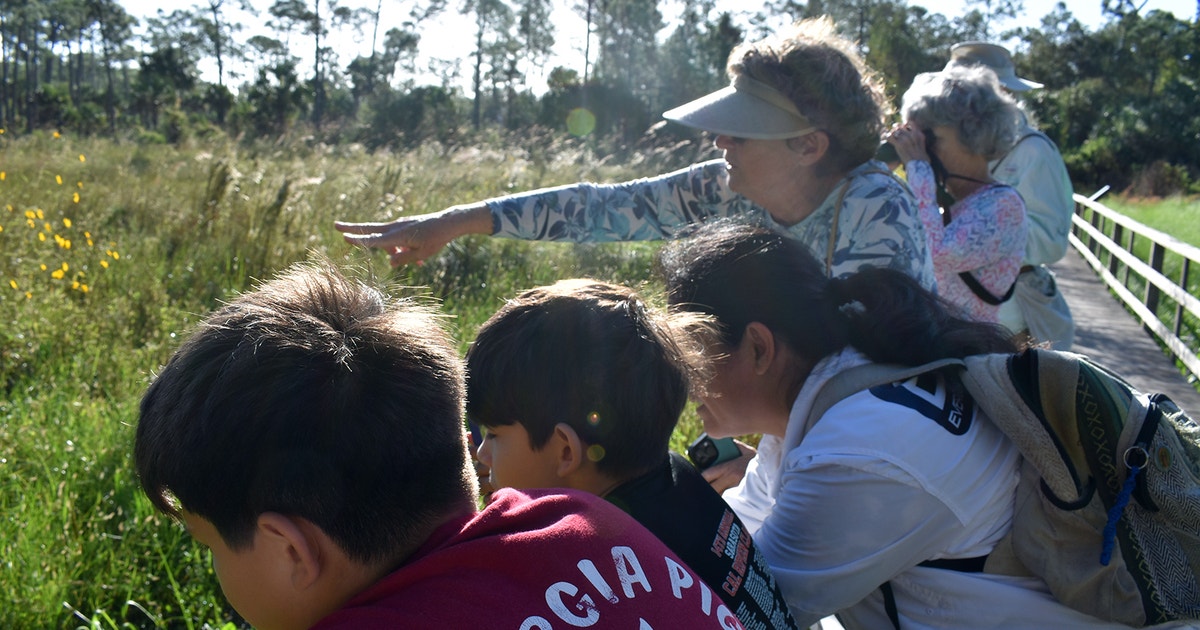
On October 20, 13 neighborhood scientists of various ages, backgrounds, and expertise set out on a mission to file each butterfly they may spot within the Sanctuary’s rely circle. Coordinated by Sally Stein, Audubon’s director of public packages, the butterfly counters break up into teams to cowl the Blair Customer Middle campus and parking space and a bit of the enduring boardwalk on foot. They later hopped on board a swamp buggy to cowl extra floor within the backcountry.
Probably the most quite a few species recorded was the white peacock, with 111 people. This species thrives in heat climates, starting from the southeastern U.S. to Argentina. It favors wetlands and different places with weedy, low-lying vegetation, akin to turkey-tangle frogfruit (Phyla nodiflora), which is certainly one of its larval host vegetation.
Different species reported in good numbers have been cloudless sulphur (65), palamedes swallowtail (30), and ruddy daggerwing (18). There have been additionally 131 Brazilian skippers: 21 have been adults, and 111 have been both larvae or pupae, curled up inside their alligator flag (Thalia geniculata) leaf “cocoons.”
NABA makes use of survey knowledge to doc species-level declines and highlights the necessity to defend butterflies from additional losses via habitat conservation, pesticide regulation, and different efforts to assist restoration.
How does this assist birds once more?
Habitat conservation and different efforts that assist butterflies additionally assist birds. Nevertheless, partaking new audiences is crucial for elevating consciousness of conservation points and provoking motion. A butterfly rely is an ideal alternative.
Corkscrew member Gloria Moorman and her sons, Tomas (11) and Rafael (8), go to the Sanctuary usually.
“Because the butterfly counting, we’re much more all in favour of figuring out totally different butterfly species,” says Moorman, who beloved seeing the outcomes of the counting as nicely. “The boys felt like they have been a part of one thing particular and greater,” she added.
The dimensions of the problem going through birds and the planet is daunting. Driving transformative change requires widespread public assist and decisive motion. Bringing folks collectively to understand and perceive what birds want is step one towards inspiring actions that defend them. Counting butterflies is a method Audubon encourages a lifelong love of birds, the Sanctuary, and the planet.
