

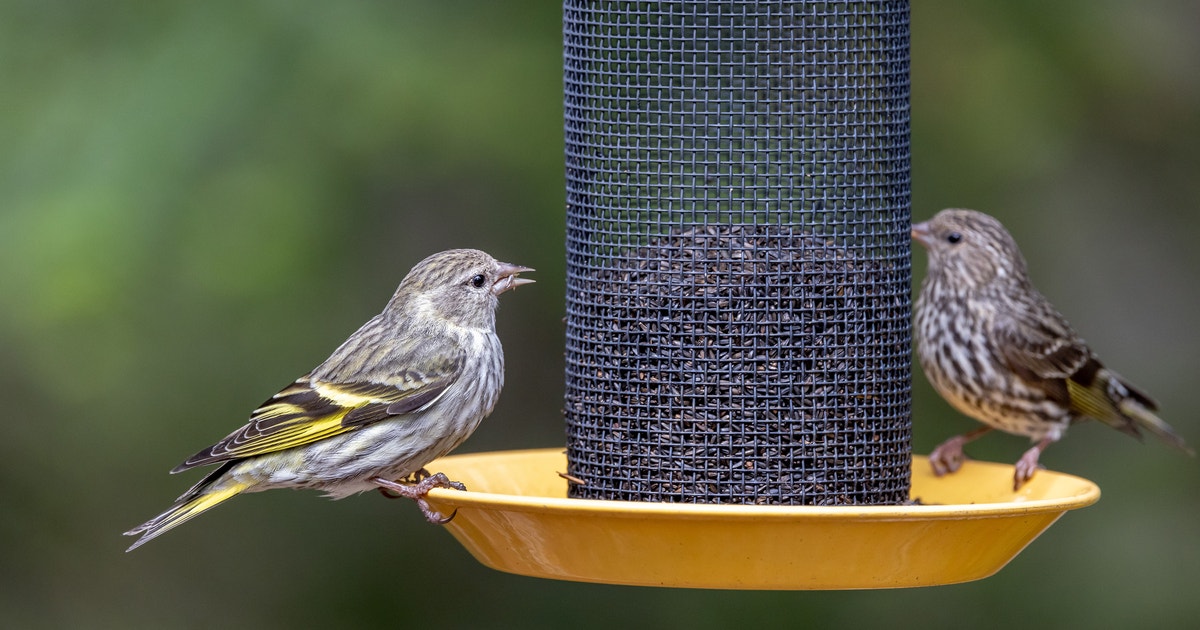
Within the winter of 2020 and 2021, Ben Tonelli was a brand new Ph.D. pupil at UCLA—however the COVID-19 pandemic meant that as an alternative of transferring to Los Angeles, he was beginning his doctoral program remotely from his house in Seattle. Whereas he labored, he loved watching by his workplace window as flocks of Pine Siskins visited his chook feeder. “It was very entertaining,” he says.
However then he began noticing sick birds, siskins that sat immobile and torpid whereas their flockmates fed and flew backwards and forwards. Finally he discovered a number of lifeless siskins in his yard. The wrongdoer was a salmonella outbreak that will finally ship 14 individuals in Washington, Oregon, and California to the hospital that winter, the vast majority of whom might trace their illness to yard chook feeders.
The siskin flocks Tonelli noticed, which helped unfold the micro organism, had been a part of an irruption—an irregular, large-scale motion of birds exterior their typical vary. So he started to marvel: May salmonella outbreaks have any connection to siskins’ irruptive habits? A brand new examine led by Tonelli and printed in January exhibits that the reply is sure, by way of a multi-year chain of occasions that begins in mountain forests removed from the cities the place birds and folks had been sickened.
The sequence begins with a warmer-than-average summer season in a high-elevation forest of spruce, fir, and hemlock timber. When a heat summer season like that is adopted by an unusually cool summer season, the timber reply by scaling again their cone manufacturing the subsequent spring.
This implies a scarcity of meals for siskins and another boreal birds the next winter, prompting them to wander extensively at decrease elevations and latitudes searching for sustenance. The result’s a flurry of special guests, generally in dense congregations, at feeders throughout the USA. Whether or not siskins deliver salmonella with them or decide up the micro organism at already-contaminated feeders is unclear, however both manner, the massive numbers of birds create the right circumstances for an explosion of salmonella. In whole, it’s a two-and-a-half-year time lag between that first heat summer season and the looks of sick birds at feeders in the USA.
Ornithologists famous an obvious hyperlink between a scarcity of conifer seeds and chook irruptions a long time in the past, and in the meantime tree scientists have begun to unravel the temperature cues that result in these ups and downs in cone manufacturing. Extra not too long ago, the Finch Research Network has begun rigorously monitoring seed crop manufacturing within the boreal to foretell irruption years for sure species.
Tonelli’s examine, nevertheless, related all of those dots and clearly linked irruptions to salmonella outbreaks for the primary time. Drawing from knowledge sources together with Christmas Bird Counts, massive databases of plant reproductive effort and wildlife illness studies, and temperature-monitoring satellites operated by NASA, he created a sequence of statistical fashions displaying how one occasion results in the subsequent. (He even obtained funding from NASA for the undertaking.)
Though he had a hunch about how the evaluation would prove, Tonelli was nonetheless stunned by the energy of the relationships he discovered. “They’re very clear,” he says. “When you have an enormous irruption, the chance of getting certainly one of these massive [salmonella] outbreaks is simply so, a lot higher.”
Though he had a robust hunch about how the evaluation would prove, Tonelli was nonetheless stunned by the energy of the relationships.
Heather Watts, a Washington State College biologist who’s studied siskins’ irruptive habits, discovered the cascade of occasions linked by the examine to be very compelling. “Going from local weather to the tree ecology to chook habits to illness outbreak and making these connections was actually thrilling to me,” she says.
In line with Watts, whereas illness ecologists have lengthy been conscious of the connections between animals’ actions and illness outbreaks, irruptions have been neglected. “This sort of irregular motion specifically has gotten little or no consideration within the context of illness dynamics,” she says. “I believe, as this paper highlights, it could possibly be actually essential.”
Tonelli hopes this undertaking might flip right into a instrument for forecasting salmonella outbreaks earlier than they happen and warning individuals to take precautions, resembling bringing of their feeders earlier than big flocks of siskins arrive. “I believe that would go a good distance in serving to defend yard birds, and likewise hopefully scale back the chance that individuals get sick,” he says, noting that it could take a corporation with nationwide attain to successfully talk such alerts.
Other than its sensible functions, nevertheless, the analysis supplies an enchanting glimpse into hidden ecological hyperlinks throughout time and area. Tonelli, now a postdoctoral researcher at Clemson College, admits that for him that is the actual draw.
“After I speak to individuals [about this], I often body it in that manner, like a loopy chain of occasions unfold out throughout years,” he says. “It’s actually neat to see these connections that you simply wouldn’t notice had been there except you actually dug into it, between issues taking place in several years and completely different locations.”
