

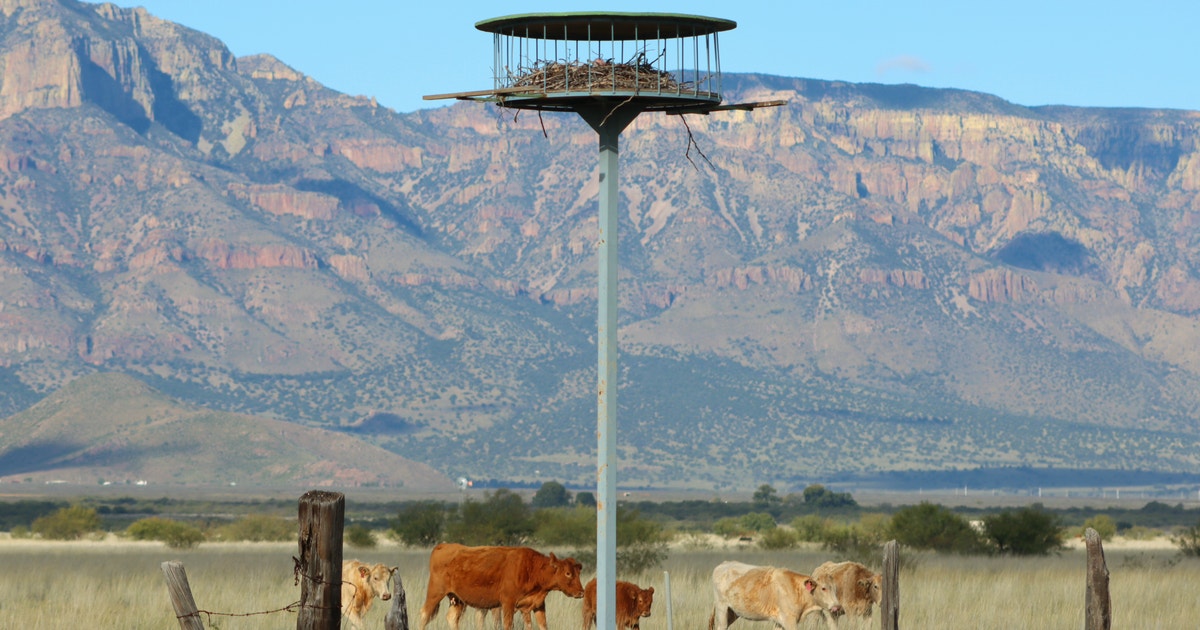
Workforce members from Audubon Southwest, Nationwide Audubon Society, and Audubon Latin America not too long ago joined Bird Conservancy of the Rockies (BCR) and Mexican companions in Chihuahua Metropolis, Mexico for the 2026 Central Grasslands Roadmap Summit. Held in mid-November, the summit served as a gathering for companions to share targets and progress for increasing sustainably managed lands within the Chihuahuan Grasslands, a area important for a lot of wintering birds just like the Aplomado Falcon (Falco femoralis) and Baird’s Sparrow (Centronyx bairdii).
Previously 50 years, grassland birds have declined greater than every other terrestrial biome, a pattern that the Audubon Conservation Ranching program seeks to reverse via partnerships with ranchers in Arizona, New Mexico, and throughout the US.
The primary two days of the summit came about on the Universidad Autónoma de Chihuahua, the place ranchers, scientists, company workers, and nonprofit organizations shared accomplishments in grassland conservation and recognized methods for overcoming sustainability challenges. Isaiah Meza, Audubon Southwest New Mexico Working Lands Program Supervisor, introduced on water harvesting and low-tech watershed restoration methods within the Chihuahuan Grasslands. The remainder of the week introduced contributors into the sector to see these strategies in observe on working lands.
On day three, the group visited Terrenates Ranch, owned and operated by Fausto Bermúdez, a member of the Sustainable Grazing Network and CEO of Ranching for Profit Mexico. Fausto proudly confirmed his regenerative strategy to administration, which mixes adaptive grazing with keyline design, a method for shaping the land to seize and unfold rainwater. His philosophy, shared by many ranchers, is that conservation must also be a sound monetary choice, one which strengthens revenue margins over time.
On day 4, Audubon workers joined rangeland ecologists from Mexican NGO Evaluación Integral y Restauración de Hábitat (EIRAH) and BCR to tour El Palmar and Las Güeras, two ranches owned by Javier Fernandez, additionally a member of the Sustainable Grazing Community. Javier depends on strategic water seize and punctiliously chosen livestock genetics to fulfill each his manufacturing and environmental targets.
On the ultimate day, the group visited El 5B Ranch, owned and operated by the Cinco Baeza household and in addition a part of the Sustainable Grazing Community. The household’s administration protects ample ciénegas (desert wetlands) whereas getting ready the following technology of conservation ranchers.
Throughout each ranch go to, a typical thread emerged: the ranchers main this work view productive operations and wholesome grasslands as one objective, not competing ones. That issues far past Chihuahua. Lots of the grassland birds that nest on the prairies of the US and Canada rely on these Mexican grasslands every winter, so their future rests on conservation that crosses borders as simply as they do. The summit confirmed that the data, instruments, and partnerships wanted to guard these birds exist already throughout the area. By persevering with to share them, companions on either side of the border can maintain the Chihuahuan Grasslands working for ranchers and wildlife alike.
About Audubon Conservation Ranching
Audubon Conservation Ranching companions with ranchers to maintain wholesome grasslands, ample birdlife, and resilient rural communities. By way of our bird-friendly land certification and science-based strategy, we empower land stewards to boost habitat, enhance soil well being and water high quality, and strengthen the connection between conservation and ranching. By buying merchandise from Audubon Licensed Fowl-Pleasant Land, customers grow to be conservationists, serving to defend America’s grasslands and the birds, wildlife, and those who rely on them. For extra data, go to www.audubon.org/ranching.
