

It’s a blinding sight: Swifts gliding, easy, by means of a lilac sky. Or a diving loon, torpedo-like, beneath the floor of a lake. However have you ever ever seen these species attempt to stroll? It’s not fairly.
Even after birds developed flight, transferring on land was nonetheless vital, says Armita Manafzadeh, a biologist at Georgia Institute of Expertise, who research avian locomotion. From raptors to waders, many birds stroll within the typical sense. Others, together with most songbirds, want to hop (for light-weight birds navigating slender branches, it’s usually quicker and extra environment friendly). Some species, together with robins, ravens, and blackbirds, stroll and hop.
“However some birds have change into so hyperspecialized that terrestrial locomotion simply isn’t vital to their existence,” says Manafzadeh. As they developed, these birds modified their anatomy to fill particular ecological niches: Foot-propelled divers, like loons and grebes, traded in good strolling legs for limbs adept at swimming. Birds that dwell totally on the wing, like frigatebirds and swifts, are such robust flyers that strolling expertise, and first rate ft, turned an afterthought. Evolution is all about trade-offs, and for these birds, strolling nicely simply didn’t make the reduce.
Swifts
Swifts spend virtually their entire lives airborne. Consuming, sleeping, mating: They will do all of it within the sky (although swifts probably mate mostly in their roosts). Many species return to land solely to breed, and a Widespread Swift holds the report for a fowl’s longest recorded uninterrupted flight, at a staggering 10 months. Among the many most aerial of landbirds, swifts’ lengthy, sickle-shaped wings energy fast, agile flight; most at residence within the sky, they doze whereas drifting on air currents, bathe in falling rain, and forage on sky plankton.
For early taxonomists, their ft weren’t value acknowledging: Their household’s scientific identify, Apodidae, means “with out ft” in Greek. They’ve ft, after all: “They nonetheless carry that very same evolutionary legacy that every one of their kinfolk do,” Manafzadeh says. “It is simply not as related to their main technique of locomotion.” Swifts’ legs are brief and weak, not constructed for strolling and even perching. As a substitute, they climb vertical surfaces to succeed in their roosts, gripping on with grappling-hook claws, and typically propping themselves up by their tails.
Hummingbirds
Alongside swifts and treeswifts, hummingbirds belong to the Apodiformes, or “with out ft,” order. Like their cousins, “they’re so optimized for flight that they’re barely transferring round terrestrially,” Manafzadeh says. They’re among the many finest flyers round, from their unmatched hovering to their epic migrations. (Ruby-throated Hummingbirds beat their wings 50 occasions a second, and can fly 500 miles nonstop throughout the Gulf of Mexico, regardless of weighing simply 3 to three.5 grams.) Exquisitely specialised for nectar-fueled, high-energy existence, hummers are stunningly quick and agile––at the very least within the air.
Beneath these buzzing wings, their legs and ft are tiny, even by the requirements of the world’s smallest birds.
Beneath these buzzing wings, their legs and ft are tiny, even by the requirements of the world’s smallest birds. They’re good for just a few issues: Preening shiny feathers, perching on twigs, and kicking rivals away during skirmishes over food. However their legs don’t have a lot power—and even knees—to allow them to’t do way more than shuffle sideways on a department for brief distances, a far cry from their gorgeous aerial feats.
Frigatebirds
Like swifts, frigatebirds spend days or perhaps weeks at a time on the wing. Magnificent soarers, they can also sleep in flight—catching thermal currents out at sea, and gliding for hours with little effort. Within the nonbreeding season, they will keep airborne for as much as two months at sea with out touching down. That’s for the perfect: Touchdown can be a nasty thought. Not solely do frigatebirds not stroll, however in an ironic twist, these seabirds can’t swim, both. They seize flying fish from the air, and pluck fish from the ocean’s floor or different seabirds, however they by no means dive in: They lack waterproof feathers and can drown in the event that they get too moist.
Tucked beneath spectacular wings—Magnificant Frigatebirds have the most important wingspan to physique weight ratio of any fowl––these “sky pirates” have brief legs and small ft, which makes for sorry strolling. When on land, frigatebirds perch on bushes and timber, and might handle an ungainly shuffle or clumsy hop between branches. However their energy and style is saved for the skies.
Loons
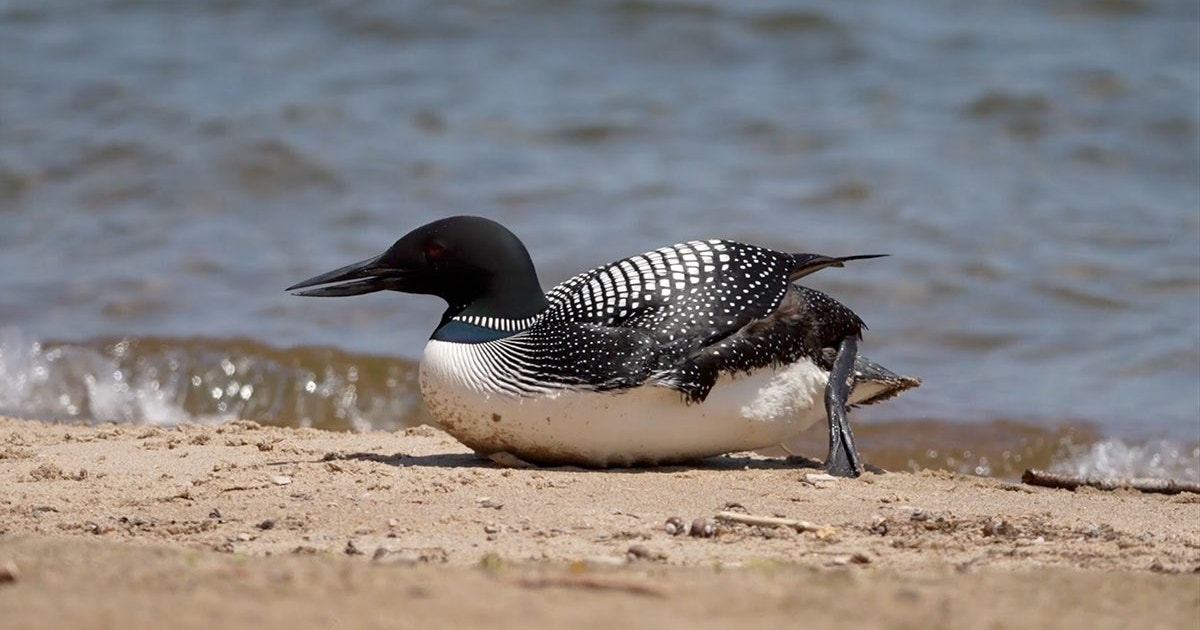
With electrical pink eyes and an eerie yodelling name, loons are haunting, good-looking, ethereal—till you see them attempt to stroll. Loons have so perfected life on the water that they hardly ever come on land besides to nest, and even then they nest by the water to simply dive again in. Actually, evolution has reorganized the loon skeleton for foot-propelled diving: Loons’ legs are positioned extraordinarily far again on their our bodies and to the facet, making them quick, deft and highly effective underwater, the place they hunt fish and different aquatic animals. In contrast to most birds, their bones are strong, bolstering that energy. “They’ve gone all in on changing into the perfect swimmers they are often,” Manafzadeh says. “However you possibly can’t win all of them, and that comes at the price of their terrestrial locomotion.”
Actually, evolution has reorganized the loon skeleton for foot-propelled diving.
Take loons out of their aspect, and so they’ll probably be stranded: For brief distances on land, they could push themselves alongside a bit like seals, however that’s about it. They will’t take off from land both, and even from very small water our bodies: Loons can run on water, however they want an honest runway to take off. In case you come throughout a stranded loon, contact a neighborhood wildlife rehabilitator to get it again the place it belongs.
Grebes
It’s the same story for freshwater-loving, scarlet-eyed grebes, whose skeletons independently developed like loons’, in a case of convergent evolution. Their muscular legs are additionally far again on their our bodies, rocketing them by means of the water. On every upstroke, their specifically tailored lobed toes fold seamlessly right into a blade, limiting drag. Grebes do not even nest on land, making floating nests anchored by crops, and nestlings don’t stroll a lot, both; they journey on their mother and father’ backs till they study to swim. When courting, grebes carry out dazzling synchronized dances, and run on water facet by facet—wings again, kicking up an not possible, silvery spray.
That trick doesn’t translate nicely to land, the place grebes’ near-vertical posture is awkward, stumbly, and usually averted (although not at all times: in this rare footage, a Western Grebe walked upright for 20 to 30 yards, stretching its wings for steadiness). Like loons, “they’re optimized for his or her aquatic existence, however they nonetheless have to take care of some terrestrial capability,” Manafzadeh says. “They simply look fairly foolish after they do it.”
Kingfishers
Have a look at a kingfisher’s burly head relative to its dainty ft, and also you’ll see why it doesn’t stroll nicely. These birds’ stocky builds and enormous heads assist heavy, daggerlike payments adept at streamlined diving and gripping fish (their main prey, at least in North America). Their payments assist with nest excavation, too: Many kingfishers nest in burrows in banks, dislodging earth by diving beak-first into partitions. Their ft end the job: They’re among the many few birds with syndactyl ft, that means their forward-facing toes are partially fused collectively—good for digging, not so good for strolling.
These short-legged, fleshy-footed specialists can’t do way more than shuffle.
Kingfishers are robust, quick flyers, plunge-diving arrowlike to hunt in lakes and rivers, and even capable of hover whereas looking for prey. However their legs are comparatively small and weak, and on land, these short-legged, fleshy-footed specialists can’t do way more than shuffle out and in of their burrows.
All species have their strengths and weaknesses, and for these extremely specialised birds, the trade-offs are just a bit extra excessive. “In case you take any animal out of the context wherein it is developed, it is not going to carry out as nicely,” Manafzadeh reminds us. “However they do an awesome job transferring across the precise atmosphere that they dwell in.” In the long run, that’s what issues most.
