

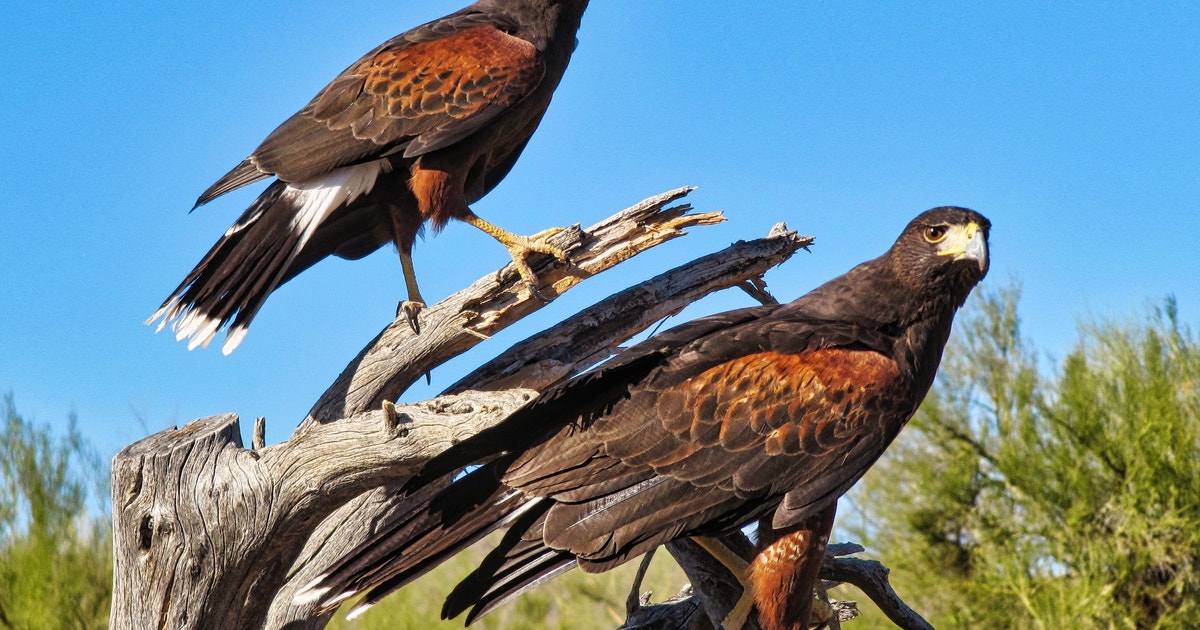
Throughout my foraging stroll by means of the desert panorama of Southern Arizona, a Harris’s Hawk flies over my head, spreading its lengthy wings then touchdown on an ironwood tree. As I proceed my path, I’m in awe of being so near its presence.
Their darkish brown feathers supply simplicity and sweetness, contrasting with vibrant rufous markings on their thighs and shoulders, adopted by a black tail with white on the base and tip, making a desert dream.
In North America, this hawk stays within the Southwest yr spherical, providing loads of alternatives to see it within the desert amongst mesquite timber, saguaro cacti, rivers, and even some suburban areas.
Many birds of prey are typically solitary predators, however Harris’s Hawks are distinctive in that they’re extremely social and sometimes work cooperatively to hunt and nest, growing their survival charges.
Thought of “wolves of the sky,” these hawks can work in teams of two or extra to flush out prey from areas whereas others intercept with an ambush for a profitable hunt. Searching collectively additionally permits Harris’s Hawks to focus on bigger prey that may assist maintain them throughout winter months, when small prey may be scarce. A meal which may have been tougher to accomplish alone has now became a household feast.
It’s typically stated that good associates have one another’s backs, and the Harris’s Hawks understand it effectively. These hawks additionally exhibit a habits referred to as “back-standing”, during which they stand on the again of one other hawk, generally with a number of hawks stacked one on prime of one other, making the group onerous to overlook.
The belief mirrored inside their looking cooperation extends into the nests of Harris’s Hawks. These hawks nest in social items of as much as seven hawks, the place they help in defending, feeding, and elevating their younger. As a substitute of instantly transferring out, older siblings additionally have a tendency to stay round for a couple of years and tackle babysitting duties earlier than leaving the household group. At occasions, even unrelated hawks be a part of the group, increasing the collective power of their nests. The nest turns into greater than a spot to boost chicks; it turns into moderately a shared duty within the type of resilience.
What appeared like only a solitary hawk perched on an ironwood tree throughout my stroll, as a substitute revealed multitudes of connections past what my eyes might see. Even a few of the fiercest creatures of the desert survive not solely by intuition, however by what occurs when a pack comes collectively.
