

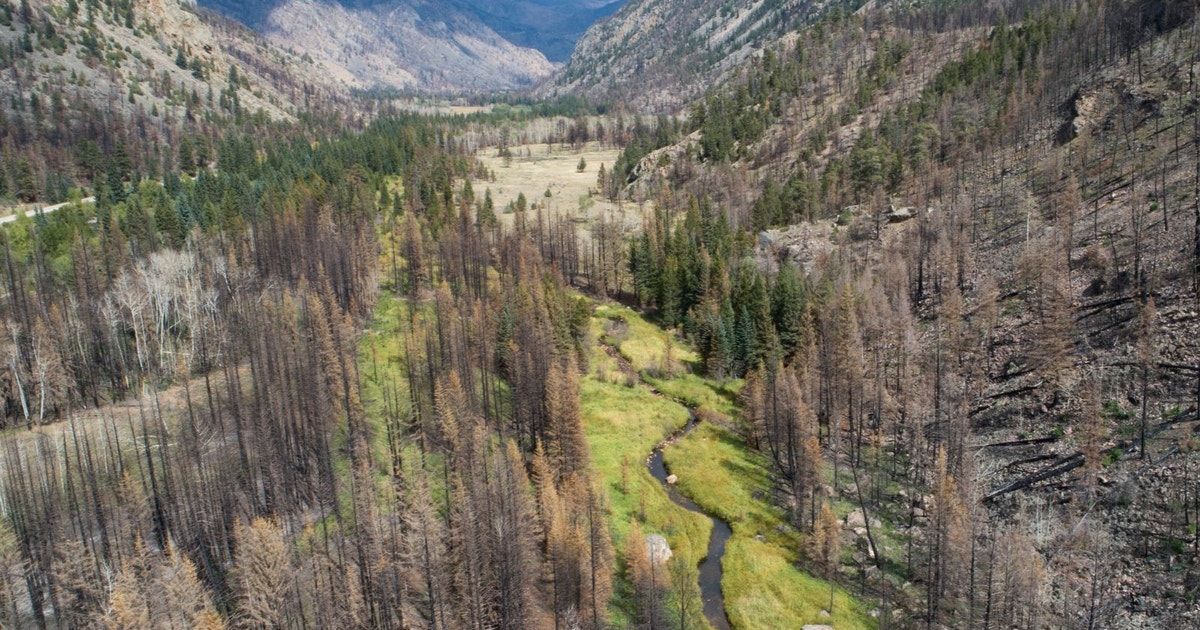
Scientific analysis reveals that prescribed fireplace, managed wildfire, and punctiliously designed thinning can assist restore forest resilience in applicable settings. However forest restoration and wildfire mitigation aren’t interchangeable.
Restoration focuses on ecological well being, together with habitat, soils, and regeneration, whereas mitigation primarily reduces dangers to communities and infrastructure. Collectively, these approaches can assist more healthy forests whereas serving to defend close by communities from harmful fires.
For birds, that distinction issues.
A 2020 Colorado Front Range study discovered that forest restoration remedies can profit chook communities, though particular person species reply in another way. Some birds favor extra open circumstances, whereas others rely on mature forests, shrubs, or standing useless timber.
Audubon Rockies and Weminuche Audubon Society have monitored chook responses to dry combined conifer forest remedies close to Pagosa Springs for eight years. Their monitoring helps doc how birds reply to forest remedies that create openings and encourage understory vegetation, offering habitat and meals sources throughout the breeding season. This monitoring additionally helps inform forest administration with the San Juan Nationwide Forest.
Analysis following the 2018 416 Fireplace close to Durango gives one other essential perspective. 5 years after the hearth, researchers discovered comparable total chook species richness throughout burn circumstances, however variations wherein species have been current. Standing useless timber in closely burned areas offered precious nesting and foraging habitat.
The lesson? Fireplace has ecological advantages, at the same time as extreme wildfires can pose severe dangers. Wholesome chook communities rely on a mosaic of habitat sorts and pure processes—not merely the variety of timber on the panorama. Managing these landscapes thoughtfully also can assist safeguard houses, assist outside recreation, and defend the pure locations Coloradans worth.
When forests burn, rivers really feel it
Colorado’s mountain forests accumulate the snow that feeds our rivers, helps agriculture and communities, and sustains wetlands and riparian habitats important to birds.
Extreme wildfire can disrupt these connections. When intense rainfall follows a hearth, ash, sediment, and particles can wash into streams and reservoirs, affecting water high quality, aquatic ecosystems, and drinking-water infrastructure. Adjustments to vegetation and soils also can alter runoff and enhance flooding.
A 2023 study in Science Advances highlights how wildfire dangers cascade via water high quality, water amount, and infrastructure, generally for years after a hearth.
Forest administration may affect snowpack. A latest College of Washington and The Nature Conservancy research discovered that rigorously designed thinning elevated snow storage by roughly 30% on north-facing slopes and 16% on south-facing slopes in Washington’s jap Cascades. Whereas outcomes fluctuate by panorama and larger snow storage would not essentially translate into elevated streamflow, the findings underscore the significance of contemplating forest administration inside bigger watershed methods.
For Audubon, forest well being and watershed well being are inseparable. How we handle forests impacts the rivers, wetlands, and floodplains downstream that maintain wildlife like birds whereas offering clear water, leisure alternatives, and different important advantages for communities.
Investing in resilience earlier than catastrophe strikes
Analysis more and more demonstrates the potential advantages of proactive wildfire administration.
A 2026 study published in Science examined 285 wildfires throughout 11 western states. Researchers estimated that gasoline remedies helped keep away from roughly $2.8 billion in damages, together with property losses and impacts related to carbon emissions and smoke. The research estimated $3.73 in advantages for each greenback invested.
These are modeled advantages, not assured outcomes for particular person tasks. However they reinforce the worth of investing in rigorously designed, science-based approaches earlier than extreme wildfire happens.
Science and sources behind Audubon’s assist
The next sources provide extra info on forest administration, wildfire resilience, water sources, and habitat for wildlife like birds.
Colorado Hen Analysis
Latif et al. (2020). Dry conifer forest restoration advantages Colorado Entrance Vary avian communities. Ecological Purposes. https://doi.org/10.1002/eap.2142
Scott & Korb (2024). Birds of the Burn: Avian Neighborhood and Useful Guild Variation 5 Years Put up-Fireplace in Heat–Dry Combined Conifer, Southwest Colorado. Fireplace. https://doi.org/10.3390/fire7030062
Forest Administration, Snowpack, and Watershed Science
Prichard et al. (2021). Adapting western North American forests to local weather change and wildfires: 10 frequent questions. Ecological Purposes. https://doi.org/10.1002/eap.2433
